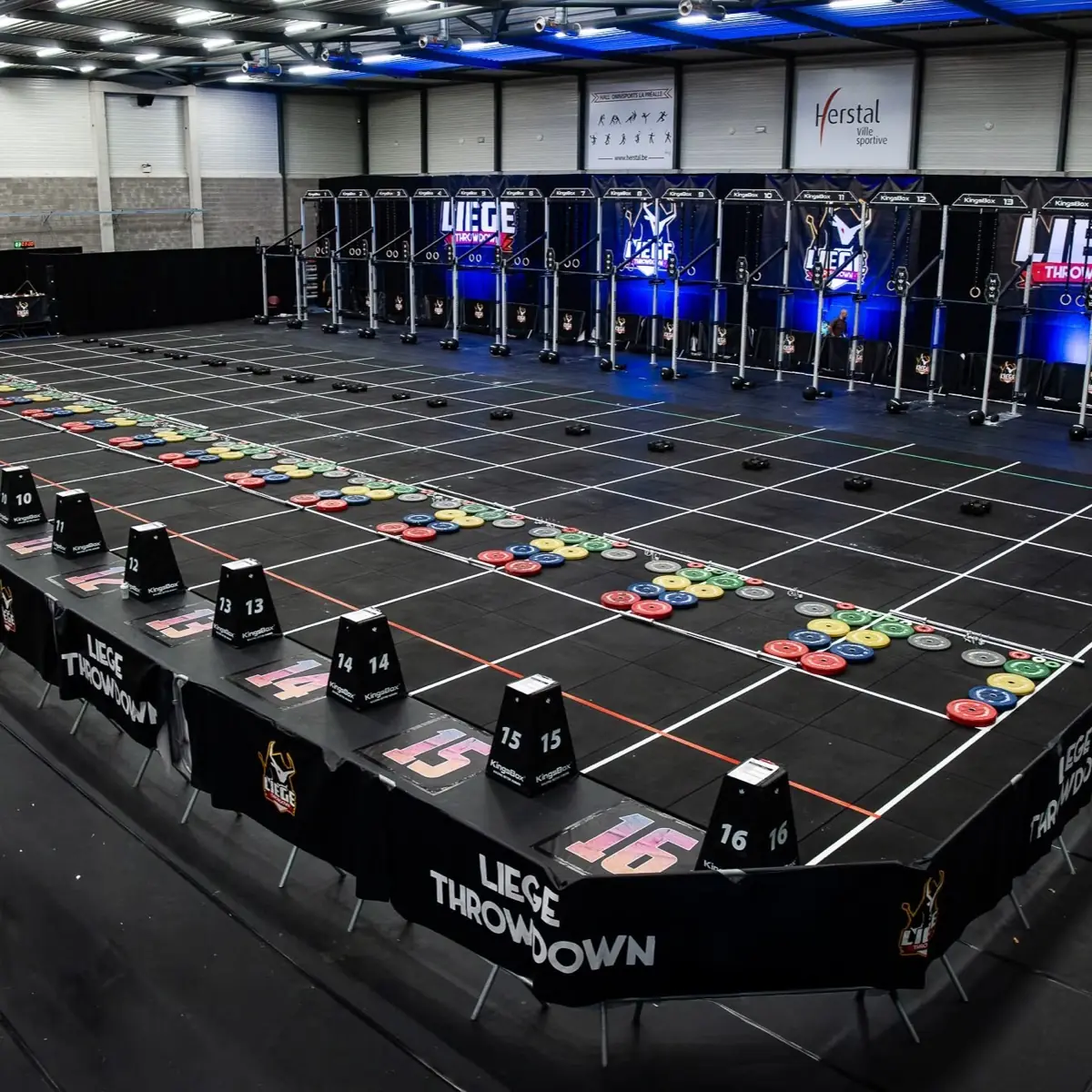
What a 415 athlete competition actually looks like
Liège Throwdown 2026 ran in Herstal, Belgium, from 14 to 16 August. The field held 285 teams and 415 athletes across 15 divisions, from individual elite to masters 35 and over, individual and team, men and women. Eight workouts were scored, from W1 - Balance Before Power to W8 - The Final Boss. The leaderboard ran on the Games method, meaning descending points awarded by placing on each workout and then summed, with ties broken by the number of first places. Everything ran on Throwdown from registration to the podium, with no spreadsheet in between. These are the event's real figures, read straight out of the platform, not an estimate.
Where the teams actually came from
This is the number that surprises organisers most. Of the 285 teams entered, only 41 came from France. Close to 86 % of the field was foreign, with 194 different clubs represented across eight countries. A well run regional competition therefore pulls far beyond its own border, provided registration, rules and leaderboard are readable in the athlete's own language. That is exactly why Throwdown runs in nine languages and settles in around twenty currencies. A German or Danish athlete who lands on a registration page they cannot read does not register, and the organiser never finds out they lost them.
| Country | Teams entered | Share of field |
|---|---|---|
| Belgium | 107 | 37.5 % |
| Germany | 66 | 23.2 % |
| Netherlands | 56 | 19.6 % |
| France | 41 | 14.4 % |
| Luxembourg | 7 | 2.5 % |
| Denmark | 5 | 1.8 % |
| Brazil | 2 | 0.7 % |
| Israel | 1 | 0.4 % |
How you move 285 teams through one weekend
With 108 heats spread over 8 schedules, one per workout. The platform filled 1,550 of the 1,728 available lanes, a 90 % fill rate, which means very little dead time between runs. Heats are generated automatically from the divisions and the number of lanes in the venue, reordered by hand where needed, and chaining recomputes every following start time the moment one heat slips. On the day, a ten minute delay on the third workout is not fixed in a spreadsheet, it is fixed by moving one heat and letting the schedule settle itself, venue screen and athletes' phones included.
| Workout | Name given by the organiser |
|---|---|
| W1 | Balance Before Power |
| W2 | The Long Grind |
| W3 | One More Round |
| W4 | Light Weight Baby |
| W5 | Ride or Die |
| W6 | Run Forest Run |
| W7 | Under Pressure |
| W8 | The Final Boss |
What it changes for the organiser
Three concrete things. Registrations arrive already structured, with division, age category, t-shirt size and any requested documents, so nothing has to be retyped. The leaderboard recomputes on every score a judge enters from their phone, and the organiser decides workout by workout and division by division what becomes public, which is how you keep the final workout suspenseful. And the money lands directly on the organiser's own Stripe account, with no intermediary holding funds. On a 285 team field the time saved is not counted in hours but in working days, and above all the podium happens at the time it was announced.
The figures in this article can be checked on the event's public pages, which stay online. The final Liège Throwdown 2026 leaderboard shows the results of every division, and the heat schedule shows the 108 heats of the weekend.
Frequently asked
- There is no subscription and no setup fee. The fee is 3 % plus 1.50 EUR per paid registration, and the athlete pays that at checkout, so the organiser keeps the full ticket price. Internal competitions with free entries and events run for a non-profit are at 0 %.
- Yes. Registration, rules, schedule and leaderboard exist in nine languages, French, English, German, Spanish, Italian, Dutch, Portuguese, Polish and Danish. Payment accepts around twenty currencies.
- Not for a functional fitness competition like this one, where judges enter scores on their phones. For a hybrid race with split times, Throwdown offers a chip timing pack for rental.
- Liège Throwdown opened theirs several months in advance, which is what we see on fields that fill. The competition page is public and indexable from the moment it is published, so the longer it lives, the more searches on the event name it captures.